
The problem
VR boxing is a genuinely physical sport: footwork, guard, accuracy and conditioning decide a round. But it has no organised competition. Matches happen in public lobbies, results live in screenshots and Discord threads, and real-world weight classes mean nothing when nobody can be hit.
The idea
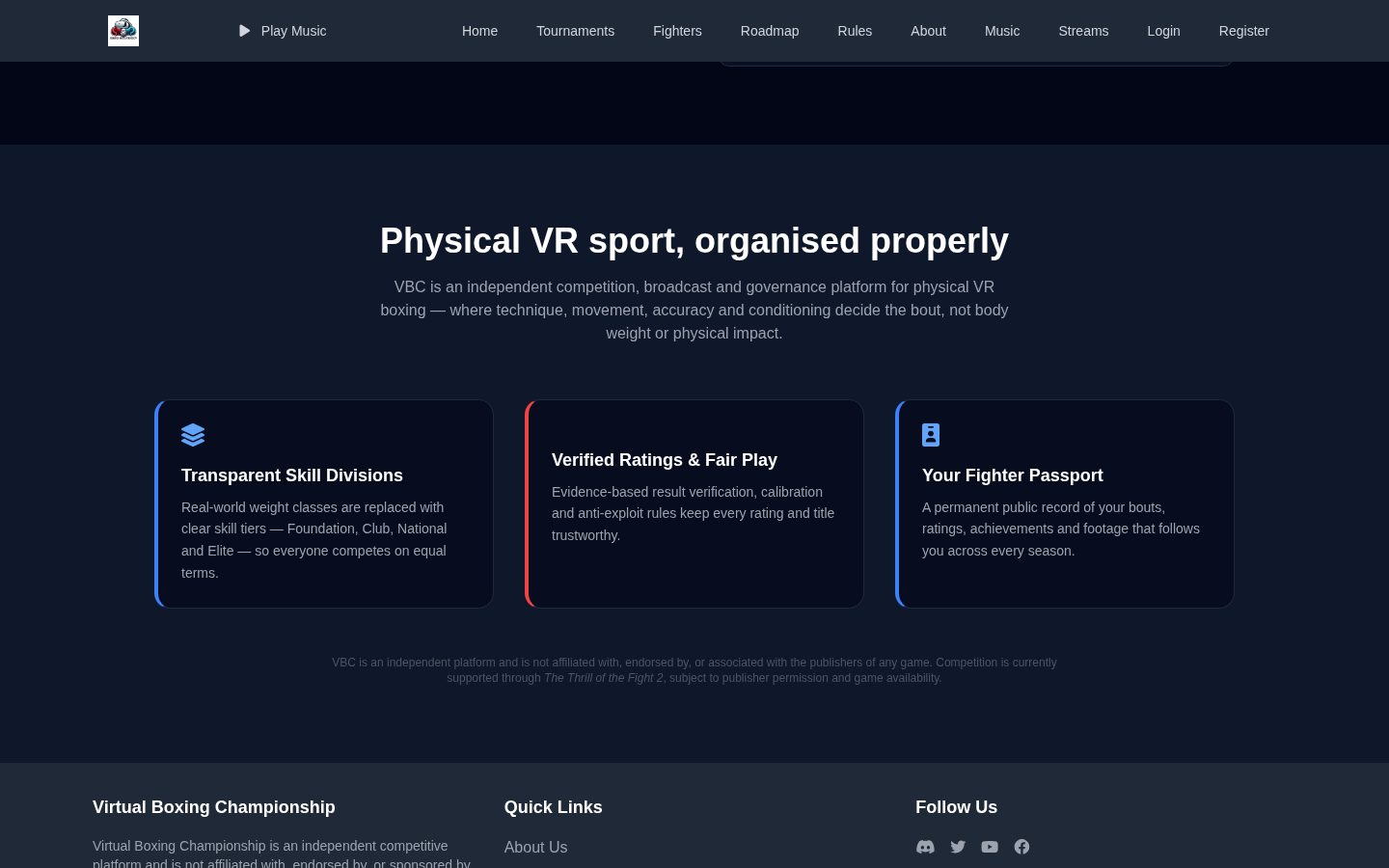
Virtual Boxing Championship treats VR boxing as a sport that needs governance: divisions, ratings, verified results, titles and a permanent record for each fighter. Fighters compete from anywhere on equal terms, and bouts can be broadcast.
Weight classes are replaced by four skill divisions, Foundation, Club, National and Elite, set by rating. Every fighter gets a public fighter passport: their bouts, rating, record and footage, carried from season to season.
Fair play by design
The hard part isn't matchmaking, it's trust. A result only counts when both fighters submit it, with the damage totals, rounds and knockdowns, and each supplies a screenshot of their rating from inside the headset. New fighters start at 1200 and play placement bouts before their rating settles.
The rules set out what a sanctioned bout needs: a stable connection with no more than 80 ms to the regional host, at least a two-by-two-metre play space, and the game's own anti-exploit mechanics. In-game referee warnings count, so three foul warnings in a round cost a point, and three knockdowns in a round is a technical knockout.
How it's built
The platform is a server-rendered Python web app with Tailwind CSS and Alpine.js, behind Cloudflare. Fighters register, set a stance, request sparring matches with a proposed time, and appear in a roster that can be filtered by division, rating range and style. Tournaments, results, streams and the rules live in the same place.
Where it doesn't fit (yet)
VBC is pre-launch: the first season hasn't started, so there are no verified results or titles yet. It also depends entirely on a game it doesn't own. Competition currently runs on The Thrill of the Fight 2, subject to the publisher's permission, and VBC is independent of the game's developers. Screenshot evidence can be faked, which is why results need both fighters and why ratings are checked, but it isn't tamper-proof. And fair play over the internet is always limited by latency and differences between headsets.
What I took from it
Most of the design went into trust: who reported a result, what evidence backs it, and what makes a rating mean something. It's the same question as identity work, asked about a sport: how do you know a claim is true when you can't be in the room?